 The Money Pages
Who Owns the Lemonade Stand?
Three friends try a pretend business—and learn that profits can turn into losses.
The first meeting of Lemonade Inc. took place on a garden bench. Priya was sitting on a wet patch.
“I vote we move,” she said.
Priya, Cass, and Theo were inventing a business for a class project. It was all pretend. No real money would change hands.
Ten pieces of a business
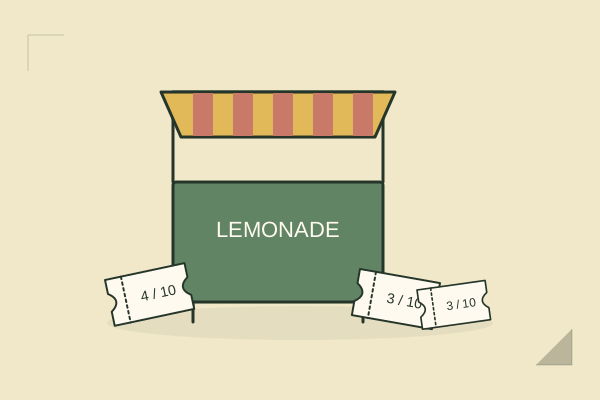
They drew ten equal ownership cards. Priya got four. Cass and Theo each got three. In their example, each card had first cost $2.
A stock, or share, is a piece of ownership in a company. Their cards were a simple way to picture it.
“I own three out of ten,” Cass said. “That's thirty percent.”
Percent means parts out of a hundred. Three out of ten is the same share as thirty out of a hundred: 30%.
Cass couldn't take three cups and call them hers. She owned part of the whole pretend business, not a pile of its cups.
A sunny weekend
They imagined selling 40 drinks for $1 each. Sales brought in $40.
Cups, ingredients, and other costs came to $25. That left $40 − $25 = $15 of profit.
Profit is what's left from sales after costs in this simple example.
They kept $5 of that profit for future supplies. They split the other $10 by ownership: $4 for Priya, $3 for Cass, and $3 for Theo.
A payment to owners like this is called a dividend. A company doesn't have to pay one.
Rain changes the plan
For the next pretend weekend, the class gave them two problems: rain and higher costs.
They sold only 15 drinks for $1 each. Sales brought in $15. Costs were $22.
They had lost $7. There was no profit from that weekend to share.
“We can't order better weather,” Theo said.
A good first weekend hadn't promised a good second one.
What would a buyer pay?
After the sunny weekend, another group offered Cass $3 for one card. After the rainy weekend, it offered only $1.
The card hadn't changed. The buyers' hopes about the business had.
If Cass sold for $1, she'd get $1 less than its first $2 price.
Real share prices can rise or fall. Companies can fail. An investor—someone who puts money into an investment—can lose all the money they put in.
Their paper cards explained ownership. They didn't promise easy money.
Money words
Stock
A share, or piece of ownership, in a company.
Profit
Money left from sales after costs in a simple business example.
Dividend
Money a company may choose to pay to its owners.
A stock is part of a company’s ownership. Its price and payments can change. Investors can lose money, including all they put in.
Your turn
What could make next weekend different for the lemonade stand?