 The Money Pages
Can Money Earn Money on Its Money?
Jules and Remy use two pretend jars to find out how compound growth works.
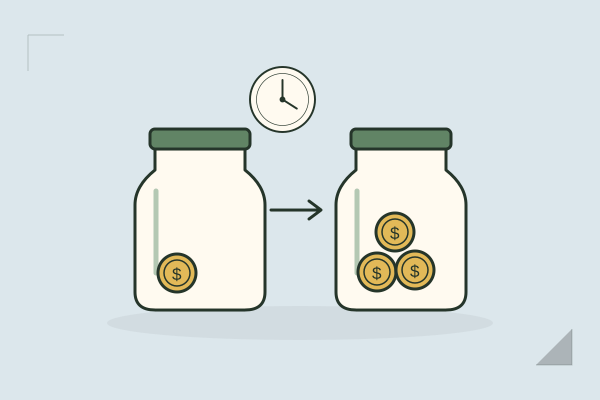
Jules wrote TIME MACHINE on one jar. Remy wrote ALSO A JAR on the other.
“Great names,” Jules said.
The jars couldn't really earn money. They were props for a made-up notebook example.
Their aunt chose $100 to start and a fixed 10% yearly rate. Ten percent means ten out of a hundred. This rate made the math easy. It wasn't a real offer or a promise.
Same start, different choices
Each jar started with $100. In year one, each earned $10.
Jules left the $10 in the jar. It now held $110.
Remy took his $10 out. His jar still held $100, and he had $10 outside it. That money would earn nothing in this example.
Both had $110 altogether. Neither added any new money.
Where did the extra dollar come from?
In year two, Jules's jar earned 10% of $110.
That's $10 from the first $100, plus $1 from the earlier $10 of earnings. So it earned $11. The jar now held $121.
Remy's jar still held $100. It earned another $10, which he took out. He had $100 inside and $20 outside: $120 altogether.
Jules had $1 more. Earlier earnings had earned money of their own.
That's compound growth. The original $100 is called the principal.
Try one more year
Ten percent of $121 is $12.10. Jules's jar grew to $133.10.
Remy took out another $10. He now had $100 inside and $30 outside: $130 altogether.
Jules had $3.10 more. Leaving the earnings in had made the difference.
What the example leaves out
“Will money always grow like that?” Remy asked.
No. Real rates can change. Fees can take money away. Investment returns—the money gained or lost—can be negative. Investments can lose value.
Savings interest and investment returns aren't the same. An account pays interest under its own rules. An investment may gain or lose money.
Prices can rise, too. A bigger number doesn't always buy more things.
Taking earnings out isn't always a bad choice. Someone may need that money now.
“The jar explains an idea,” Jules said. “It doesn't tell the future.”
Money words
Principal
The starting amount, before earnings are added.
Compound growth
When earlier earnings stay in the balance and can earn more.
Interest
Money paid for the use of money. Some savings accounts pay it under their rules.
Keeping earnings in can let them earn more. The fixed rate in this example is made up. Real rates can change, and investments can lose money.
Your turn
When might someone need to take earnings out instead of leaving them to grow?